In January 2026, the Museum team delivered a talk for the Lewisham Local History Society presenting initial findings from the cataloguing of the Ken White Postcard Collection as part of the ‘Wish You Were Here’ project. This included showcasing some stories that the team had found, demonstrating examples of the fascinating narratives that will emerge as the project continues.
I joined the team attempting to grapple with the Ken White Postcard Collection (KWPC) in the summer of 2025, once all the individual postcards had been bagged and numbered and the systems of classification were well established. This is to say, I selected my box of postcards (Box 6) without any preconception of their contents or what historical period may be illuminated within. Box 6 ranged from the 1940s up to the late 1960s, so where other researchers found stories from the trenches, correspondences to and from the great houses built in South London after the raising of the Crystal Palace, and one postcard alluding to the rise of Nazism in Germany, I found the great majority of the postcards I categorised to boast bright coloured piers and flower gardens along seaside promenades, flagging the repeat key words of ‘holiday correspondence’ and ‘discussion of weather’. Postcards being used for holiday correspondence is not a post-War phenomenon, but the percentage of postcards about having arrived in Deal, or Bournemouth, or Torquay shot up.
Over the months of cataloguing this did considerably limit specific interest in the content of the cards. Alongside flagging keywords about the content and picture on the front, we logged where the postcards were sent to and from, who they were sent to and by whom, and if they had any remarkable stamps or postmarks. This final data set is where my research veered away from the team, a greater number of the postcards I was cataloguing had slogan postmarks as the stamp obliterator, alongside the constant town mark detailing the day the postcard was sent and where from. The repetitive nature of the content thus opened itself to tracking the history of the postcard and postmark as a tool for mass communication, detailing the commercialisation and professionalisation of the postal system in the 20th century.
The postmark is the ink stamp on the right side of a postcard, by the stamp. The first postmark was introduced by the English Postmaster General Henry Bishop in 1661. It showed the day and month a letter had been sent to prevent late deliveries by private postal companies. Whilst in the late 19th and early 20th centuries the postmark would be used to obliterate stamps, these marks preceded the stamp by nearly 200 years. The private delivery companies of the 17th century realised the commercial value of the mandated mark and used it to expand their potential markets by boasting fast delivery times
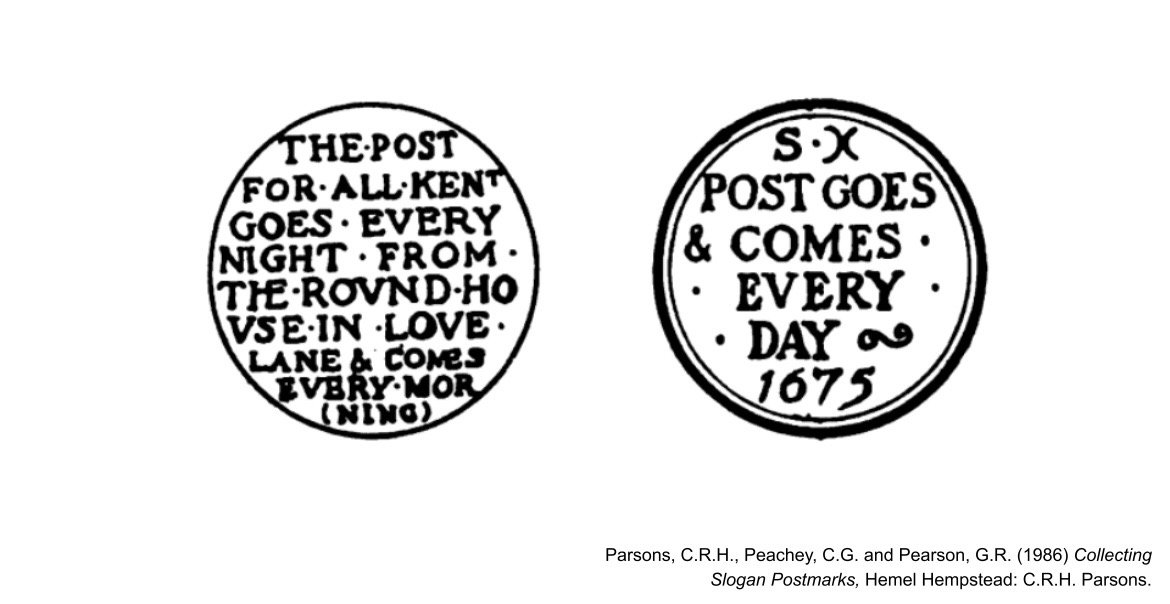
The first stamp was rolled out on May 7th 1840, and the stamp obliterating postal mark followed across the Empire by the 1850s. Despite the pioneering postal system in Britain, the adoption of text based postmarks, able to print slogans came about comparatively late, even compared to other countries in the Empire. In part, this was due to a desire not to cause unnecessary agitation in colonised countries, for fear that such a large amount of post was leaving the metropole for the then-colonies, any Britain specific slogans may upset the carefully curated sense of unity.
Campaigners had urged the Postal office to adopt advertisable stamp cancelling machines as early as 1871, with Pears, the soap company, suggesting an obliterating postmark bearing the word “PEARS”. The attempt was thwarted. The Government itself became the first allowed to exploit the stamp obliterating postmark for public advertising, with 1917’s plea “BUY WAR BONDS”.
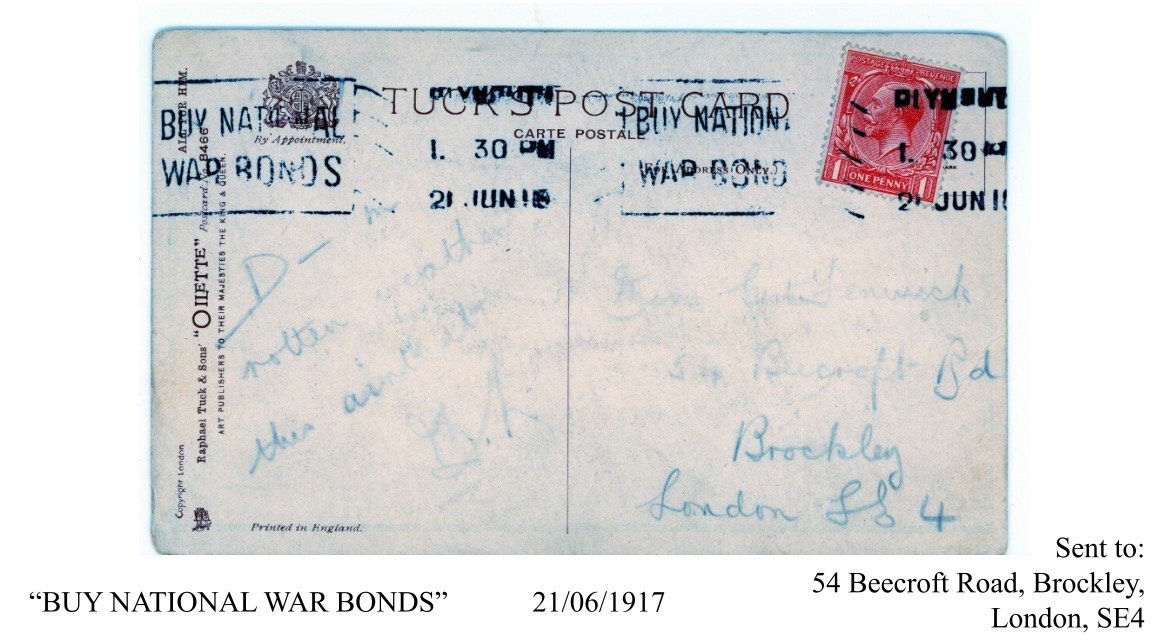
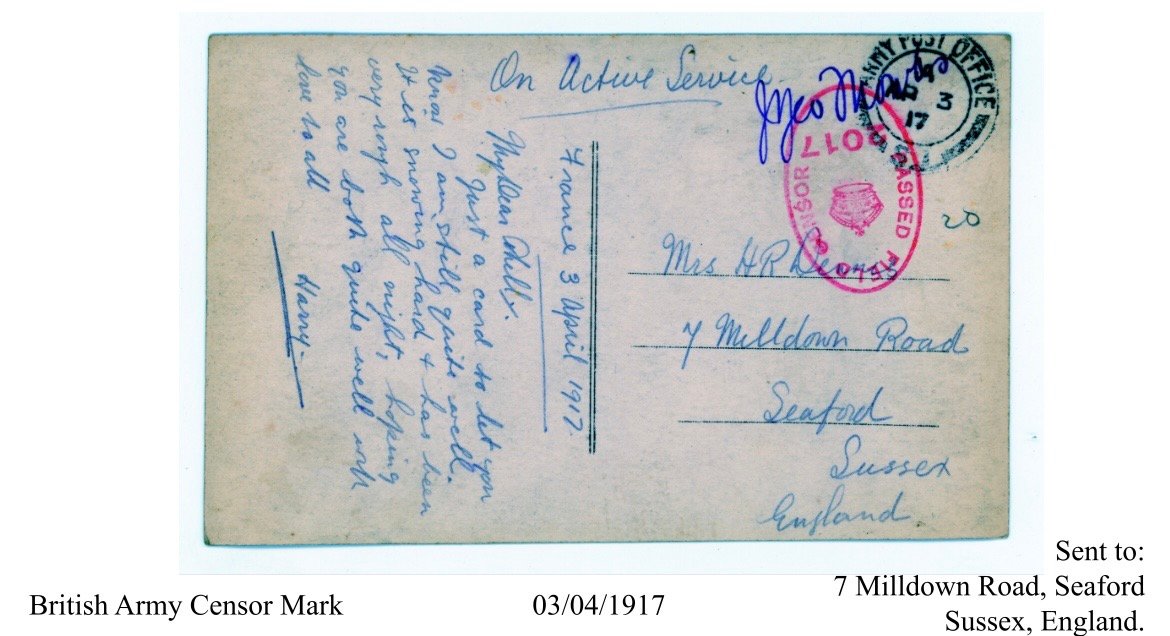
The earliest in the KWPC is from 1917 and was sent to Beecroft Road in Brockley. This was not the first time words were used to obliterate stamps in Britain, but previous public usage had been limited to military usage, such as the censor marks we found in the KWPC.
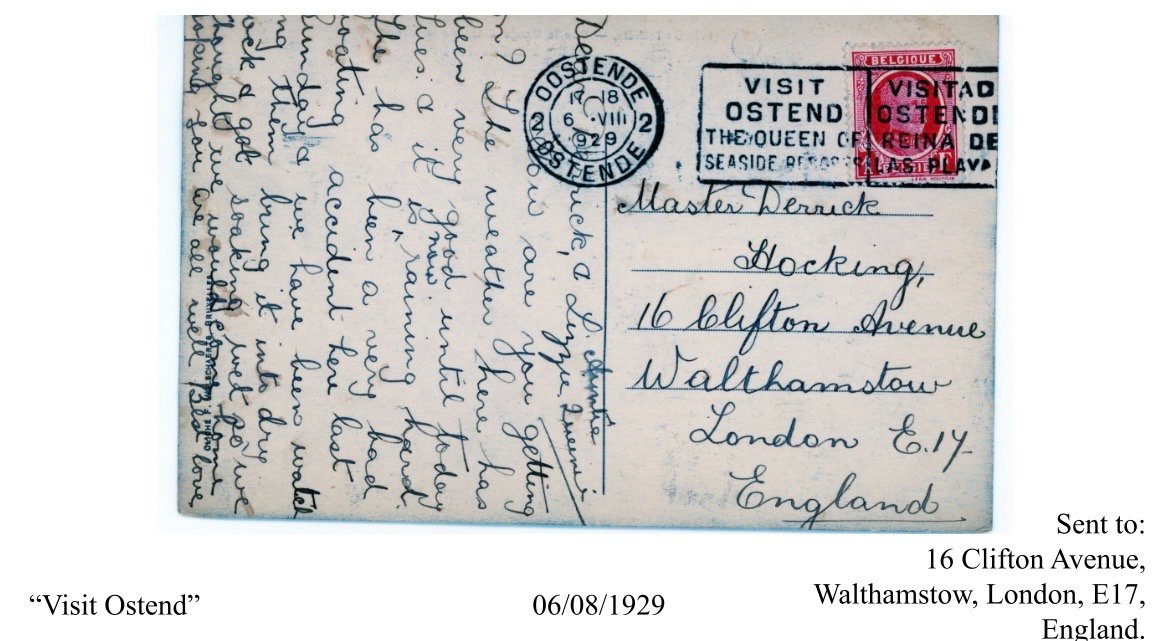
Meanwhile outside of Britain, postal slogans were already being used for local promotion such as this postcard we catalogued encouraging people to visit Ostend! The UK wouldn’t release an equivalent postmark until 1956 for the Rochdale centenary, unfortunately none if these have about in the collection at this stage.
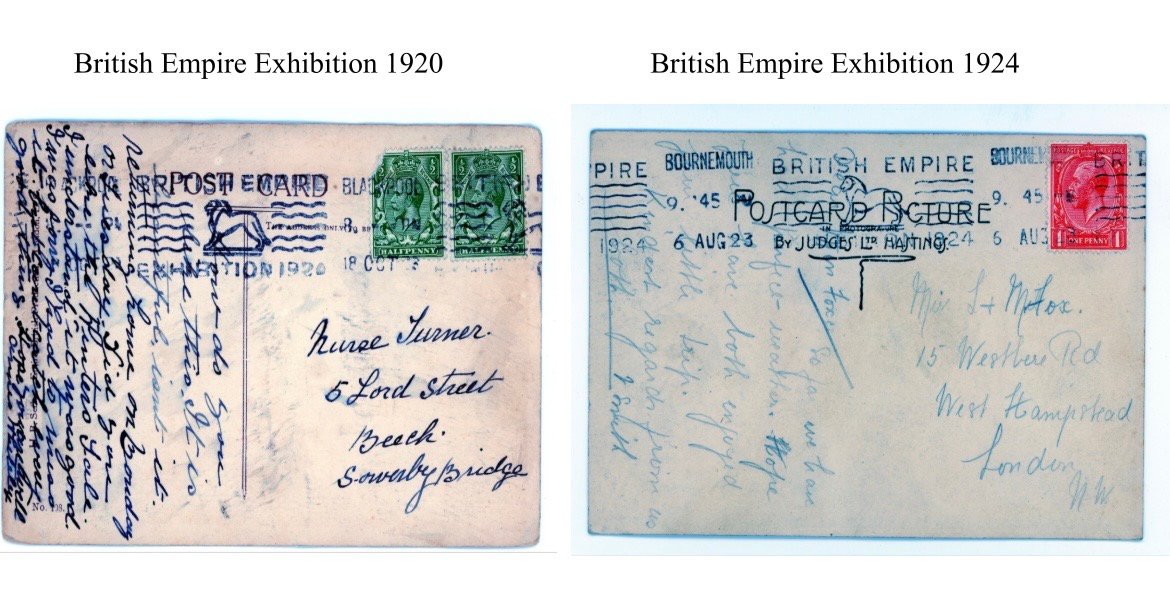
After ‘BUY WAR BONDS”, the first postal slogans stamped in peace time were used to advertise countrywide government adjacent events. Many postcards from the 1920s bore the mark “BRITISH INDUSTRIES FAIR” and “THE BRITISH EMPIRE EXHIBITION”.
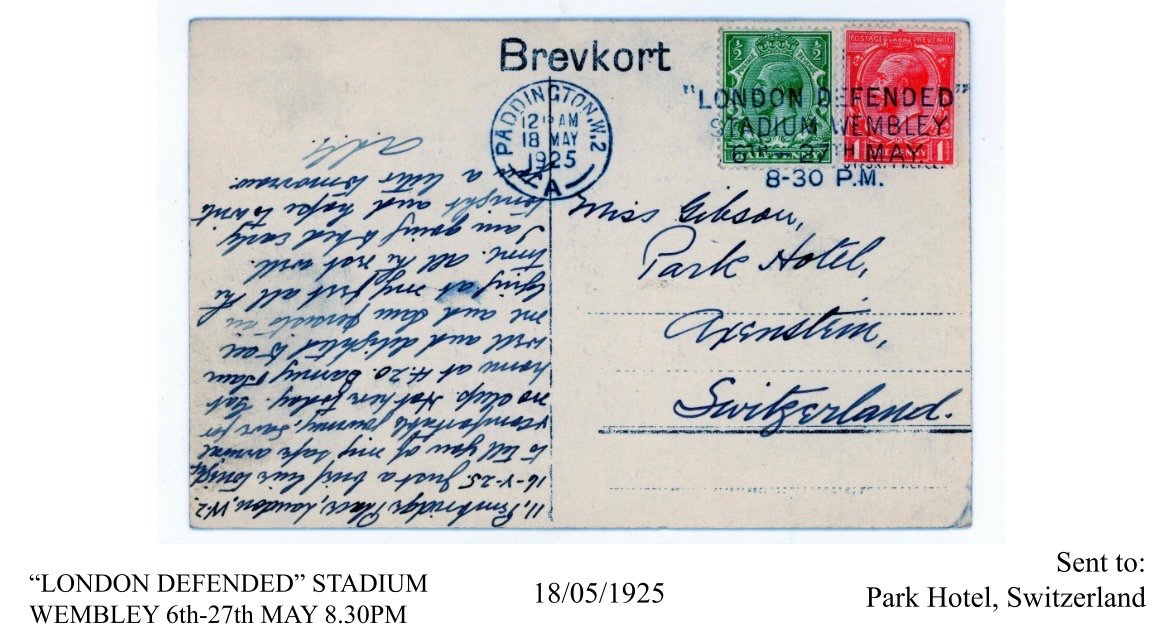
Some postcards we came across from 1925 read “LONDON DEFENDED WEMBLEY STADIUM” advertising an airshow at Wembley Stadium, itself only two years of age, between May 9th and- June 1st which saw the NO. 32 RAF squadron flying overhead, firing blank ammunition into the crowd, dropping pyrotechnics to simulate shrapnel and engineering explosions to imitate the effect of German bombs crashing onto a pitch which just a fortnight prior had seen Sheffield United beat Cardiff City 1-0 in the FA Cup final.
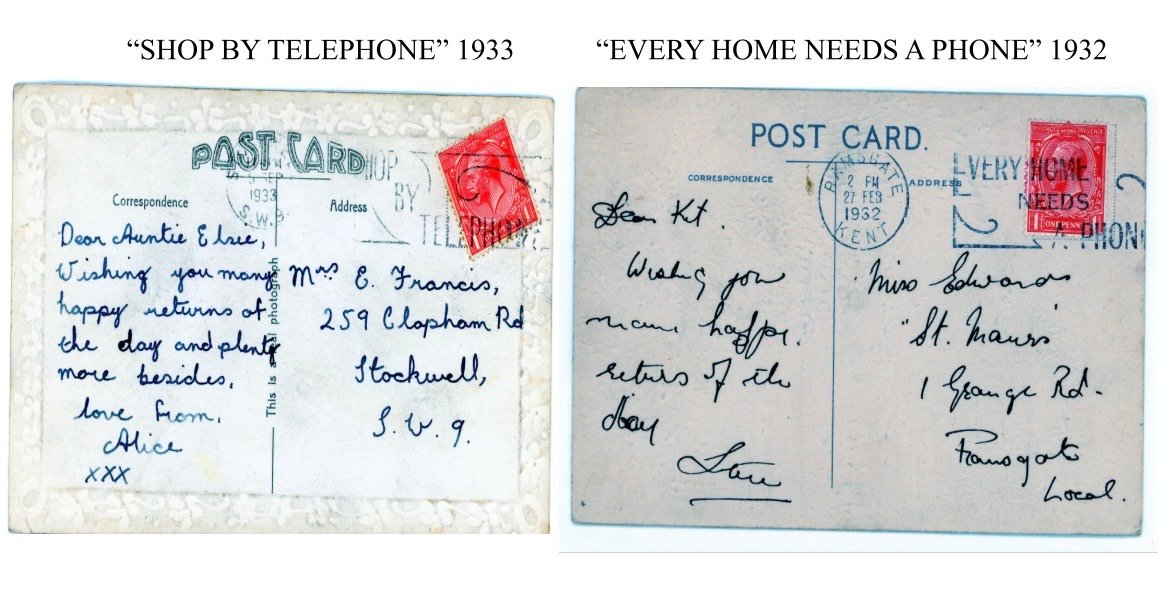
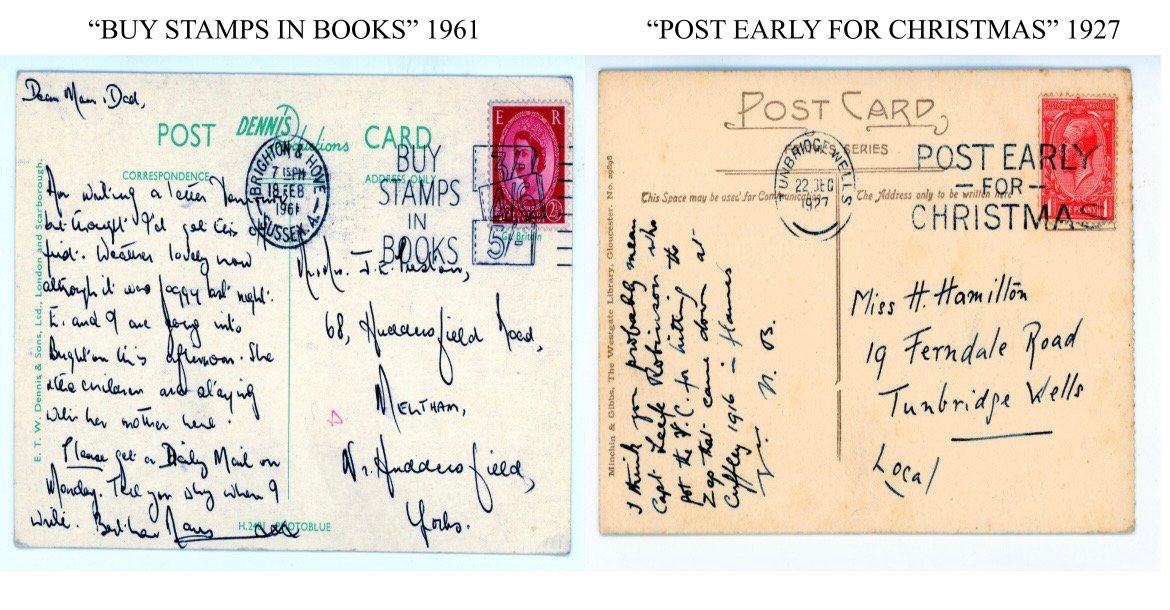
As the 1920s and 30s drew on, the slogan post mark was exploited for the promotion of new technologies e.g. “SHOP BY TELEPHONE” and “EVERY HOME NEEDS A PHONE” or for the Postal Office’s own public service announcements e.g. ‘POST EARLY FOR CHRISTMAS” and “BUY STAMPS IN BOOKS”.
In 1926 provisions had been made to begin private advertising on the postmark, but this was scrapped following public backlash and an editorial from the Mail claiming the the plans would be illegal under the Postal Office Acts, though the Office itself would put the scrapping down to insufficient potential to generate funds. Following the Second World War attempts at mass government marketing expanded e.g. “FLY BRITISH AIRWAYS” and “TAKE NO CHANCES KEEP DEATH OFF THE ROAD”, as did general public informational messaging encouraging giving blood, and even postmarks aimed outside of the British Isles e.g. “Visitez le Grande-Bretagne”. Still, the slogan postmarks continue throughout the KWPC to reveal a modernising Britain, but still under the strong grip of the central government using post as a subtle form of mass communication.
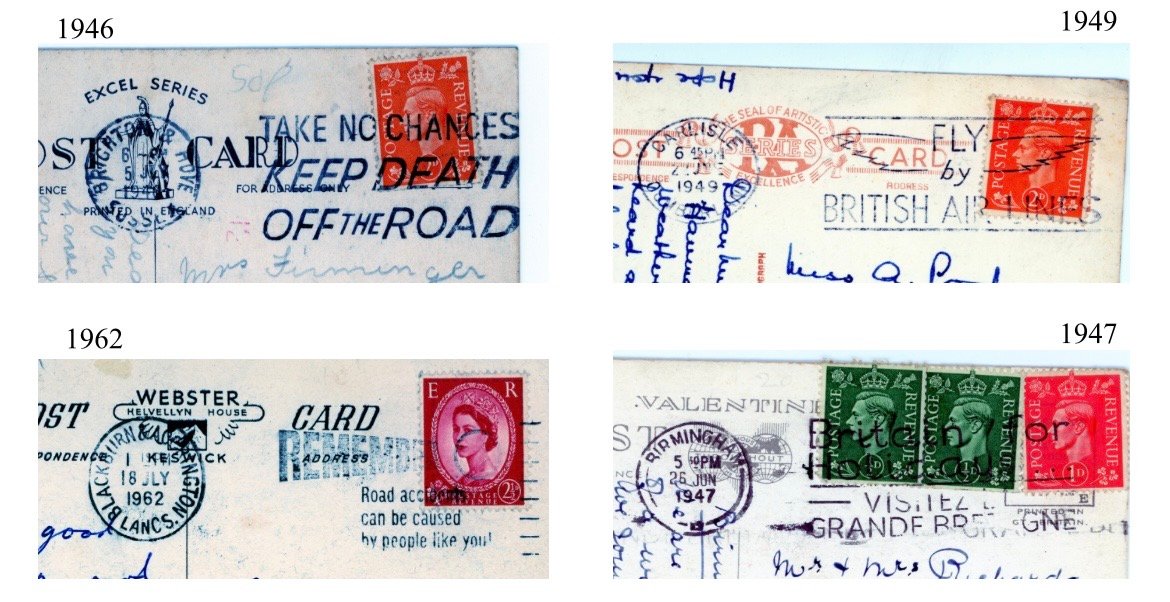
Some slogans would appear more commonly in the collection than others, a microcosm of the effect of the roll out of these campaigns. Slogan Ostmarks were generally specific to certain post offices, even if they were intended for national distribution. The sponsor of a postmark would arrange for their distribution in such a way as to ensure the largest coverage for the least money as possible. A national slogan like “FLY BRITISH AIRWAS”which commonly cropped up in the KWPC, running from the Second World War til 1963 would be the result of the production of 350 dies (which would stamp the obliterating mark) to 250 sorting offices, generally targeting large towns.
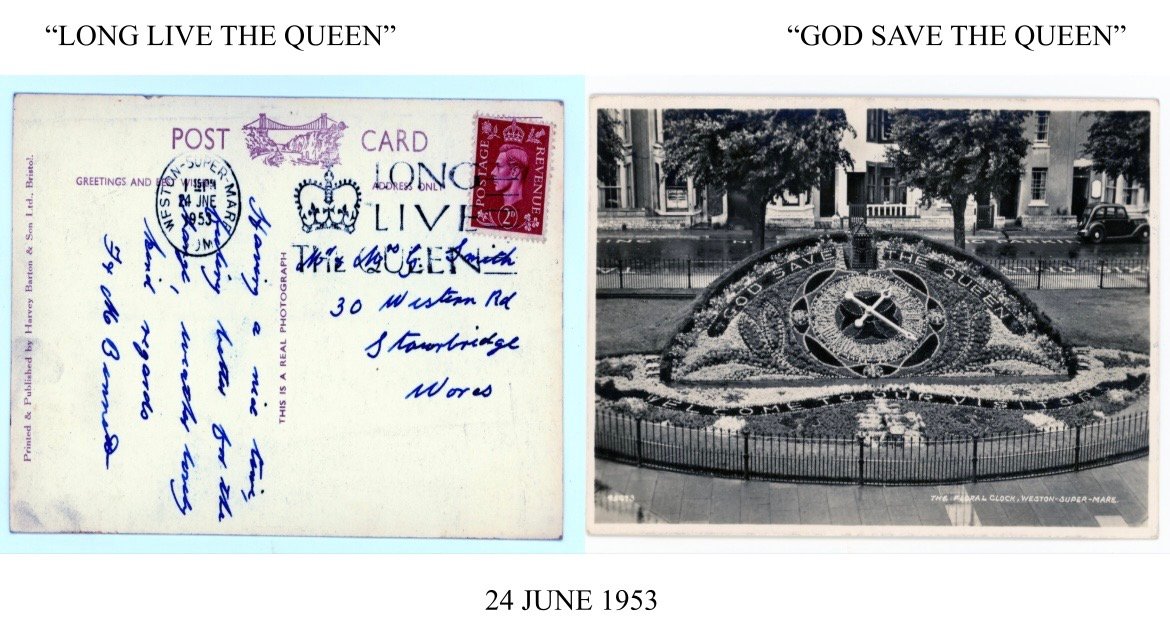
The notable exception to this trend for nationally rolled out postmarks were issued for the Victory, the Royal Wedding of Elizabeth and Phillip and the Coronation, for which 921 dies were issued. The postmark once again acting as the subtle hand of state messaging, at a rate where other such tools lagged. One such example, a personal favourite of mine in the collection, bearing a “LONG LIVE THE QUEEN” postmark matching a flowerbed arranged for the Coronation, but sent with the stamp of the deceased King George VI.
In South East London the participating sorting offices for slogan postmarks were London SE1 Delivery office in Bermondsey, Camberwell SE5, Catford SE6, Eltham SE9, Lewisham SE13, Peckham SE15, and Woolwich SE18. Catford and Lewisham were deleted from the National list during revisions in 1960. As for local slogans, they wouldn’t appear until 1956, and only then to celebrate civic anniversaries or local events. It was not until the 1st of April 1963 that postal slogans promoting tourism or investment, like that sent from Ostend, were permitted in Britain, just in time for the average Briton to surface from the financial struggle of the War and consider a seaside holiday.
Some of my favourite postmarks in the collection appear from 1965 onwards, when ladening rules allowed for pictures on the postmarks. The success of these postmarks and the renewed hope of advertisers to exploit the space led to a substantial change in the marking of postcards by post offices. When we came to analyse each postcard from the KWPC, one of the most useful tools was the town mark, the small circular stamp which allowed us to identify when and where a postcard was sent from. This was to the left of the stamp, with the postmark and its obliterating lines or slogan over the stamp to the right. Useful to researchers, yes, but inopportune for paying sponsors whose designs became obscured by the stamps underneath, or cut off by the edge of a postcard. From July 1st 1963, however, this would change. The circular impression was allowed to be used as a stamp obliterator on the right, with the postmark on the left.
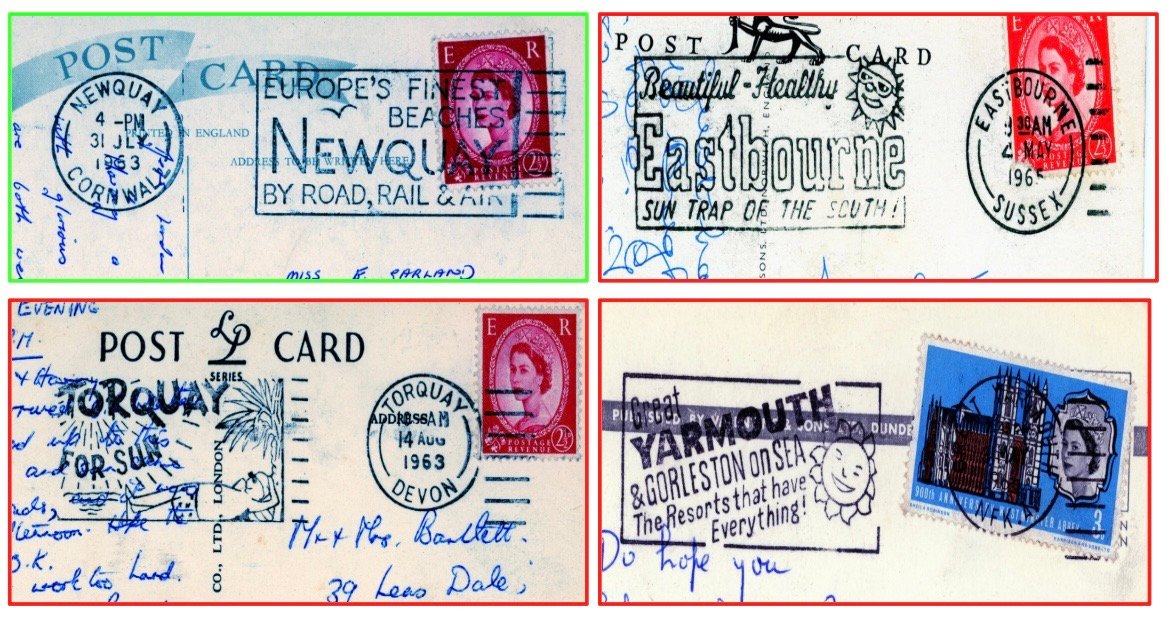
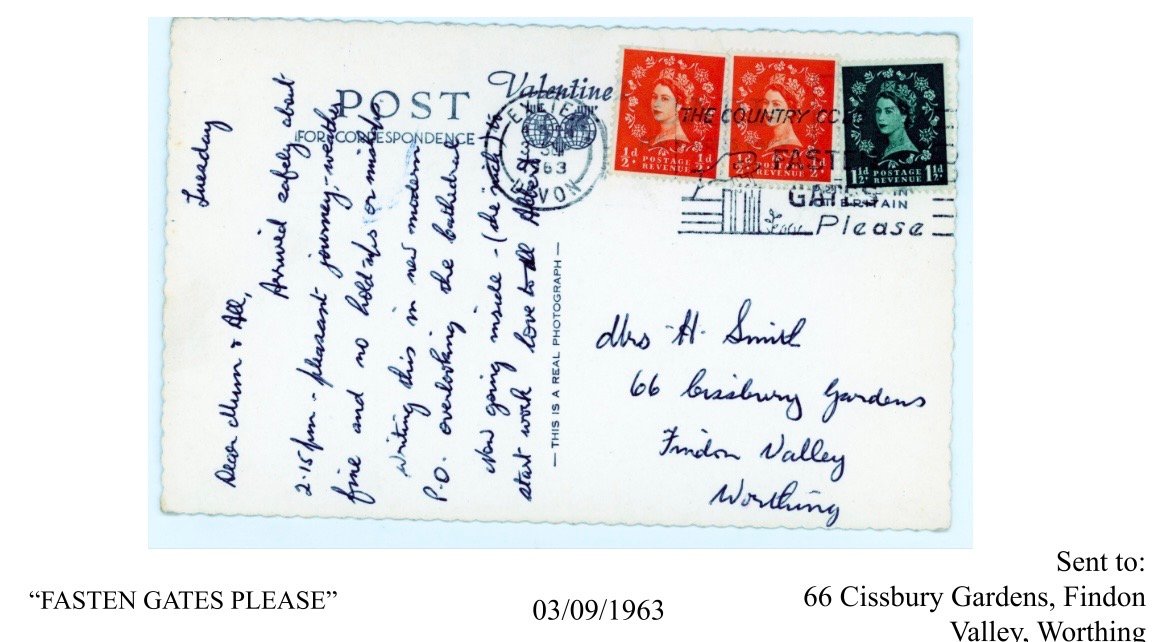
By 1968 this order was commonplace and would be standardised by 1976. And thus, the desire expressed by Pears in 1871 was fulfilled 100 years later, the postal slogan and its potential for mass marketing was ultimately realised, usurping the practical postal function of the mark and town stamp. However, The KWPC illuminates that the development of the postmark was still largely taken advantage of by local action groups or the Post Office itself. One postmark that appeared in the collection urging the fastening of gates was the result of a campaign of only 10 dies used in 12 offices (two were transferred) distributed in Devon.
Among the most important in this collection are from Norwich which mark not just the use of local slogans in the 1950s, but the standardised introduction of the postcode, first trialled in Norwich in 1959, before being rolled out to Croydon and beyond from 1966. Whenever a town got a proper, 6-digit postcode, a postal slogan was issued “REMEMBER TO USE THE POST CODE”, running for 6 weeks or longer.
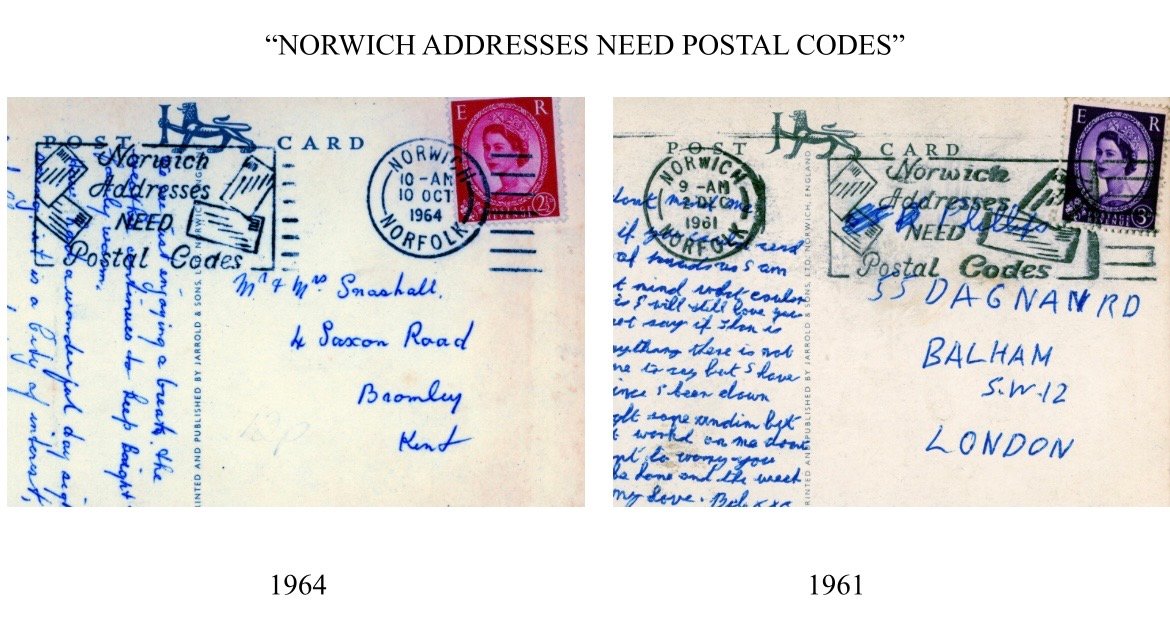
My research of the KWPC never went enough post the 1960s to be able to confidently analyse the development of slogan postmark technology beyond this time, which would have likely been affected by postal strikes in 1971, and the introduction of the first class stamp. But, using the data drawn from KWPC we are able to map out a history of the Postal Service as a tool for fast mass communication, seeing Britain evolve from a centralised nation with war at the heart of its concerns, to a consumerist, holidaying economy with a formalised civilian postal system.
Though the stories we can draw out from the collection may be more obviously interesting, the postcards bare witness to much more than the lives of the people who wrote them, if what we can pick up from the postmark obliterating the stamp can be so revelatory for the change of British society over the course of the 20th century, what can the stamps tell us, the producers of the postcards, the change in addresses and post offices and holiday destinations tell us about our history. As such I am glad to have been drawn into this history through an often resented repetitive logging of “discussion of weather” and “holiday correspondence”, though sometimes I may have wished for a bit of gossip along the way.
Kate Fothergill, Archive and Research Assistant